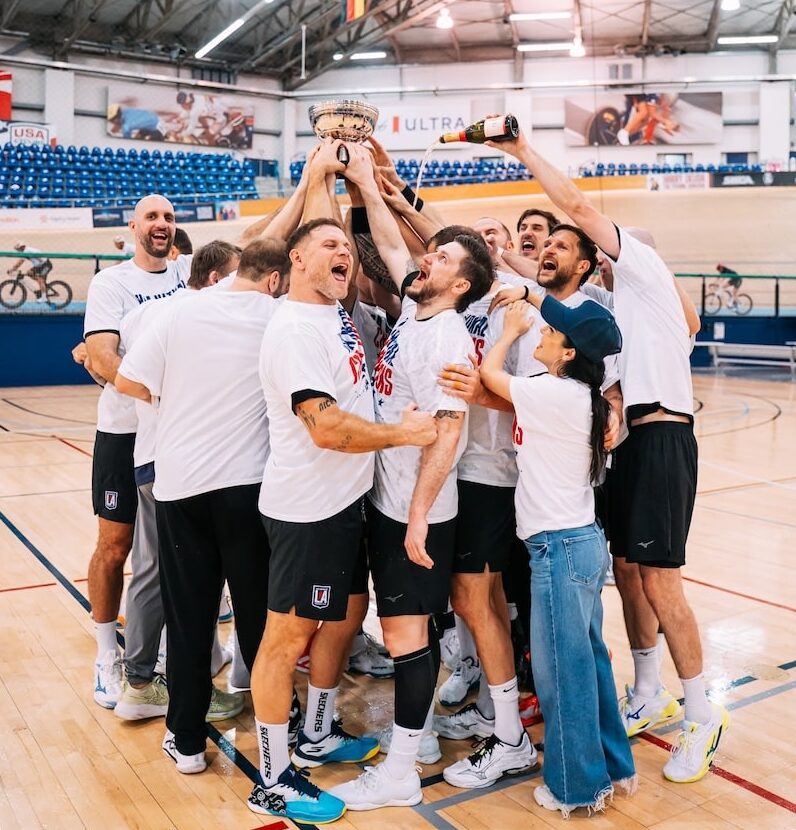
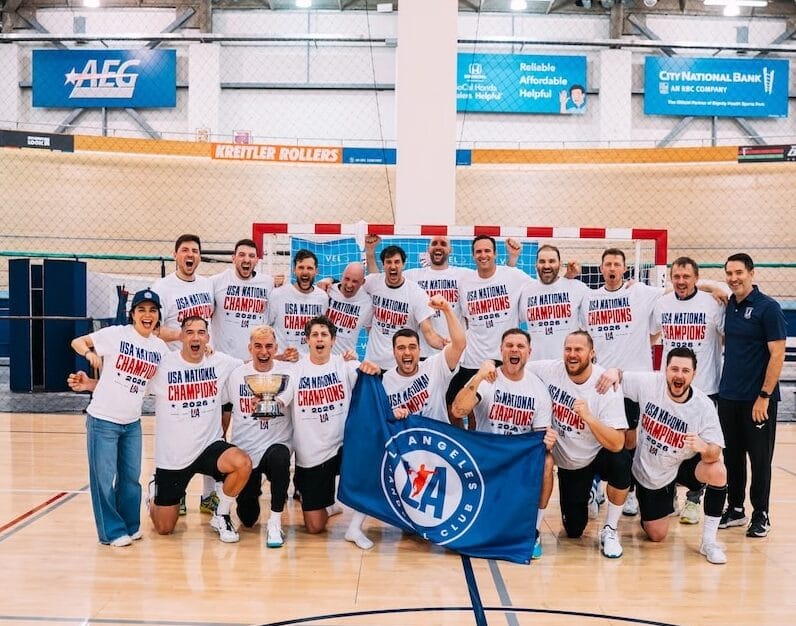
Los Angeles Handball Club.
Photo: Los Angeles Handball Club
From podcast empire to national champion in just five months – Lewis Howes is all-in on handball. In this exclusive interview with GoHandball, he shares his vision for Los Angeles Handball Club, his Olympic ambitions, and why leadership could make or break the sport in the United States.
When Lewis Howes talks about handball, it’s not just passion, it’s a 16-year commitment.
Known globally as the host of the hit podcast The School of Greatness, reaching more than 25 million people weekly, Howes has built a career around high performance, mindset, and storytelling. Before becoming a leading voice in personal development, he was a professional arena football player, and that athletic identity never left him. Over the past decade and a half, he has quietly become one of the most visible ambassadors for team handball in the United States, representing the national team while documenting the journey to grow the sport.
Now, as president of the Los Angeles Handball Club, he’s stepping into a new role: builder. In just five months, the club has won a national title, attracted global stars, and created a buzz rarely seen in American handball. With the 2028 Olympics on the horizon in Los Angeles, Howes is aiming even higher, both for himself and for the future of the sport in the U.S.
Here is GoHandball’s exclusive interview with Lewis Howes:
What is your long-term vision for Los Angeles Handball Club, and where do you see the club in 5–10 years?
“For 16 years, I’ve been documenting my handball journey with the USA Men’s National Team, while also sharing about it on my podcast The School of Greatness. Since taking over the Los Angeles Handball Club five months ago, our vision is to build the premier handball club in the USA. Several great teams have succeeded by investing in local youth programs and creating a culture of success within, and we hope to do the same.”
How would you describe the current level of team handball in Los Angeles compared to when you first got involved?
“Within 5 months of becoming club president, we won the USA National Championship, built the largest social media following in North America (surpassing the USA National Team’s following), created awareness globally, grew local excitement and membership in Los Angeles, and attracted some of the world’s biggest handball stars to play with our club.
It’s been a full team effort, aided by all our players, the LA community, and the leadership of Yan Victorov and Michael Hinson who spearheaded our growth.”
What makes LA a good (or challenging) market for growing handball?
“LA is the Olympic city for 2028 and the second-largest city in the USA. It is the entertainment capital, and some of the world’s greatest athletes live here. The biggest brands and many elite colleges are here, and it’s an attractive city for working and living.
The challenge is that the area is so spread out, traffic is difficult, and public transportation is limited. This makes scheduling practices that work for everyone harder.”
How are you working to attract new players, fans, and sponsors to the club?
1. Marketing: “Handball is still an unknown sport for Americans, so the only way to grow it is by marketing it correctly and building a brand people want to join. This involves creating the right type of content to raise awareness and turning your players into stars through media. If you have great players but your city or the world isn’t aware of them, that’s doing a disservice to your club and the growth of the sport.
2. Mindset: Bringing the right people together, fostering a growth mindset, and creating a brand people want to join helps the community grow. This means setting new values and standards for your club to ensure this mindset thrives. It’s also important to empower people to do what they do best and allow them to grow within the club.
3. Money: A sport won’t grow with the right marketing and mindset alone, it also needs money and sponsors to cover expenses. Since taking over LAHC we have raised nearly $200,000 in donations from my friends and social media following. Like all clubs in the USA, the Los Angeles Handball Club is amateur. And since we currently don’t have membership dues from our athletes, our leadership team covers all expenses for court time, gear, entry fees, etc.”
What motivated you to return to playing competitive handball after focusing on your business and media career?
“I’ve been playing since 2010 when I moved from Ohio to NYC to learn the sport. The only reasons I paused playing was because of the pandemic and an injury, but handball has always been on my mind.
For 16 years I’ve run my business while traveling back and forth to the previous residency program in Alabama, playing with club teams, traveling the world with the National Team, and training in Europe to improve my skills.”
How has your mindset as an athlete changed compared to earlier in your career?
“Earlier in my career, I was more reckless with my body and would overtrain. Now, I’m more strategic with my training, recovery, and mindset. Before I was probably more selfish in my play, but now I really think about how the entire team can succeed in the best way possible.”
What has been the biggest physical and mental challenge in making this comeback?
“Learning how to pace myself. I used to manage two-a-day workouts easily, but now the focus is on efficiency and staying healthy to best serve my teammates and make an impact.”
How do you balance training with your responsibilities as an entrepreneur and podcast host?
“By eliminating distractions in my life. I don’t go out to dinners, I don’t party, and I don’t stay out late. I get up early to train, work on my mission during the day, and focus on recovery and family time at night and on the weekends.
I have a business that impacts many employees and also reaches over 25 million people weekly who consume our inspirational media. I focus on my health, my mission, and my family and handball. I don’t have much extra time for anything else during this season of life.”
What does a typical training week look like for you right now?
“Depending on whether we have handball practice, a tournament, or a game, I normally work out four times a week with my trainer in the mornings. I then do an activity like pickleball or active recovery and rehab a couple of times a week to support my training.”
How realistic do you believe your chances are of competing in the 2028 Olympics in Los Angeles?
“I believe it’s all up to God. If I can continue to improve as a player, contribute to the USA National Team and stay healthy, I believe God will put me where I’m meant to be to serve the most people. Currently, the National Team has many great players, so many things would need to go my way for my chances to increase.”
What would it mean to you personally to represent the United States on home soil?
“It would be a lifelong dream come true. I’ve dedicated the past 16 years of my life to handball, playing and promoting it on my platform. I’ve sacrificed a lot in my business to travel and train for the USA National Team.
I’ve gone through many injuries in the past and experienced pain during recovery as well. I’ve always had to spend my own money to be with the National Team as well because the USA Handball leadership hasn’t been able to raise money and secure sponsors to support its athletes.”
What needs to happen, for you and for Team USA, for that Olympic dream to become reality?
“For myself, staying healthy, continuing to add value and trusting God if it’s my path. For Team USA, they need a leadership team capable of fundraising, marketing the sport, and placing the right people in positions for the athletes to win.
Currently, the entire USA handball community has many concerns about the questionable decisions being made, which points to significant uncertainty. They haven’t raised any money in the past few years, and there’s a lot that needs cleaning up.”
How far is the U.S. men’s national team today from being competitive on the global stage?
“With the right leadership to fundraise, bring in top coaches, market the sport to recruit great athletes, and develop youth programs, anything is possible over the next 5-10 years.”
Los Angeles Handball Club. Photo: Los Angeles Handball Club
Do you think hosting the Olympics will significantly accelerate the development of handball in the U.S.?
“USA Handball missed a massive opportunity with the 1996 Atlanta Olympics. They did the best they could with what was available at the time, but in 2028 the landscape has changed. There was no social media then, but now with new sports exploding around the U.S. due to social media and increased brand investment, we have a massive opportunity to build this sport.
If leadership does not start making wise decisions now, it will be the greatest let down and the biggest miss for USA Handball. There will be a lot of hype and great media coverage for a short window of time, but nothing will happen after if they don’t start doing things differently now.”
Why do you think handball has struggled to gain traction in the United States compared to other sports?
“There are very few youth programs, no professional league, and playing is difficult due to a lack of facilities. It’s up to the leadership within the clubs and the federation to find a way to overcome these challenges.”
What are the biggest misconceptions Americans have about team handball?
“They think it’s easy to play. I’ve heard a few NFL players publicly say they could easily assemble a team and win a gold medal. Thats just not the case and it’s a disrespect to all the great players from other countries who have been playing the sport since they were kids and are dominating on a global level.”
What role do media and storytelling play in growing the sport in the U.S.?
“It’s everything. The USA Team Handball Federation has failed at this. They lack the marketing and content creation abilities because they cannot fundraise effectively. If USA Handball fails to raise money and hire the right people, it will never reach its full potential.”
How important is school and college-level development for the future of handball?
“It’s part of the key to success, but it will require much more than that.”
You have a large platform through The School of Greatness – how do you plan to use it to promote handball?
“I’ve been promoting since the first day I started, posting hundreds of videos, photo posts, and conversations on my podcast The School of Greatness to my platform of 25 million followers over the years. There was even a documentary about my initial journey with the NYC Handball Team here.”
Have you noticed increased interest in handball from your audience since you started sharing your journey?
“Yes, the more I talk about it the more people become invested in my journey and learn more about the sport.”
What role does leadership play in building a sports movement from the ground up?
“Leadership is everything. To succeed, you need capable people with the right skills who know how to grow a business by building winning teams, executing effective marketing, and generating capital. If leadership has never done this before, you will never be able to bring the right people together and empower them to thrive. This is one of the main struggles USA Handball currently faces.”
Do you see yourself continuing in handball, either as a player, owner, or promoter, after the 2028 Olympics?
“100 percent.”
What would success look like for you personally by the end of this journey?
“Being proud of myself. Following the vision God has for me. Staying healthy. Making a difference to the people around me. Inspiring my audience to live their best lives. Helping put USA Handball on the map. Having a beautiful relationship with my wife and inspiring my twin daughters to pursue their dreams.”