

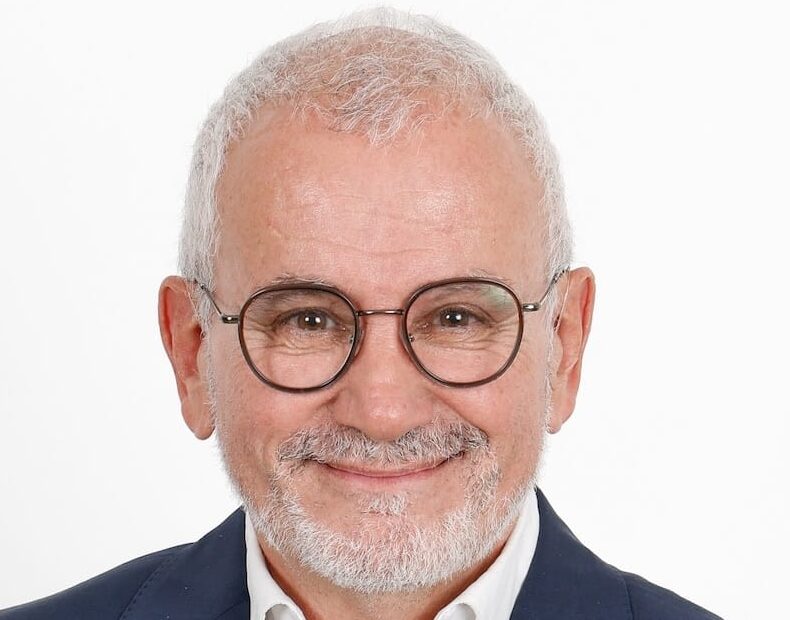
Speaking to GoHandball ahead of December’s IHF presidential election, Philippe Bana – president of the French Handball Federation and candidate for IHF vice president – made the rare move of publicly declaring France’s vote. In a landscape where most federations avoid commitments, Bana says he “won’t change his mind” and views the three European challengers as “confusing.”
“France will vote for Hassan Moustafa because he is the best candidate,” says Bana.
The conversation with Philippe Bana does not begin with electoral tactics or political positioning. Instead, he talks about Paris – about the “more than 750,000 spectators” who filled the arenas during the summer of 2024, about a sport carried by momentum, visibility and pride. In Bana’s eyes, the IHF presidential election is happening at a pivotal moment, at “a crossroads for the IHF federation,” as he puts it. And from the very beginning of the interview, two things become clear: he has already made up his mind, and he is not especially interested in the ambiguity that surrounds several of his European colleagues.
France, he insists, has not held internal discussions about the election. Not because it is unimportant, but because the federation is “so focused on our programs in France and our targets.” Yet even without formal debates, Bana describes a long-standing direction – a strategy rooted in meetings with other major European federations.
“More than two years ago, I discussed a lot of international top federations like Sweden, Norway, Denmark, Germany about what we should do over the next period of handball at the international level. We met in Basel and discussed it, after which we agreed a strategy to try to enter the IHF council to bring the best we can to the handball world.”
It was, he explains, a collaborative vision led by former Danish president Morten Stig Christensen. After Christensen sadly passed away in november 2024, Bana says he made a conscious choice: to continue the plan and stay aligned with the shared vision they built together.
And in that strategy lies his electoral clarity.
“France will vote for Hassan Moustafa because he is the best candidate. And the fact that there are three candidates from Europe is a bit confusing,” he says.
He says it without hesitation – in fact, he expresses surprise that others hesitate at all. While many federations are keeping conversations behind closed doors, or refusing to disclose how they will vote, Bana has no intention of adjusting his stance. “I don’t know why other federations find it hard to speak about which candidate they are voting for,” he tells us. “I won’t change my mind.”
A defence of continuity
His support for Moustafa is grounded in what he describes as stability, institutional memory and incremental improvement. When asked to assess the president’s long tenure, he does not engage with the criticism that has circulated for years.
“He has always been interested in regulation and to improve systems. I don’t see any other president who would have been so invaded in all the competitions. And I believe that the creation of the IHF Trophy was incredible.”
While observers and opponents point to stagnation, lack of transparency or the need for renewal, Bana leans into continuity – and warns against what he calls a culture of criticism directed at people in leadership.
“I don’t like the guys shouting at the people who lead organisations. It’s very difficult to lead. Hassan still has a very clever brain. You can’t speak only about the president but you have to speak about the whole organisation.”
Europe divided, and an election lacking unity
If Bana’s loyalty to Moustafa is unwavering, his frustration with Europe is equally visible. He describes a fragmented continent with three competing candidates, none of whom, in his view, have clarified their vision enough to unify the region.
“It’s a weak moment for Europe with three candidates when we all need to be together in the same boat,” he states.
He repeatedly highlights the absence of cohesion, contrasting it with the earlier cooperation he remembers from the Basel meeting. For Bana, unity is not only strategic – it is a responsibility. As he puts it: “people must be elected on their program as well, not only who they are as a person.”
On Olympic status, fear narratives and the alternatives
Two of Moustafa’s challengers – Franjo Bobinac and Gerd Butzeck – have argued that handball risks losing its Olympic status. Bana dismisses the idea outright.
“The Olympic status is not in danger. The results of the Olympics are very clear and therefore the status is not in danger for handball.”
On the other candidates themselves, he stops short of engaging in criticism. But he makes one position explicit:
“I think Hassan Moustafa is the only candidate who would be able to handle all of it, as it relates to being president of the IHF.”
The silent federations – a growing fault line
As the interview turns toward development, membership structures and the integrity of the voting system, Bana becomes more careful. France, he notes, is already helping “30 countries” and is in “contact with six federations in Africa,” positioning itself as a development engine inside the sport. His proposed path forward focuses on education, school programs and the IHF Trophy.
“The IHF Trophy is an incredible tool. A lot of things can be improved for sure, but the IHF can not do everything themselves.”
But when asked directly about nations with no activity, no website, no ranking – so-called “ghost federations,” whose votes may influence the presidential election – Bana rejects the premise.
“I don’t think that there are any ghost federations.”
It is a striking answer, given that dozens of member countries offer no verifiable evidence of active handball structures. Bana acknowledges challenges, but frames them as developmental rather than legitimacy problems:
“In some countries there are not that many people working with handball, we can call them emerging nations. It’s not easy and it takes time to build and develop a sport in a country.”
He describes his own frequent travel to Africa and Oceania to underline the complexity of building sport infrastructure globally. To him, the issue is not whether these federations vote – but whether they receive enough support to grow.
A candidate – and a continent – moving in different directions
In the end, Bana’s position reflects a broader tension in international handball: a major European nation fully committed to the incumbent, at a time when some European federations are (not openly) searching for alternatives. He stands for continuity when others argue for change; he rejects the existence of “ghost federations” when observers warn they undermine credibility; he speaks of unity while Europe fields three competing candidates.
But he is, unmistakably, consistent.
He will follow the strategy he helped shape with Christensen.
He will vote for Moustafa.
And he will not apologise for it.
As the election nears, Philippe Bana’s stance reveals both confidence and contradiction – a powerful federation with a clear position, in a landscape where clarity has become rare.