

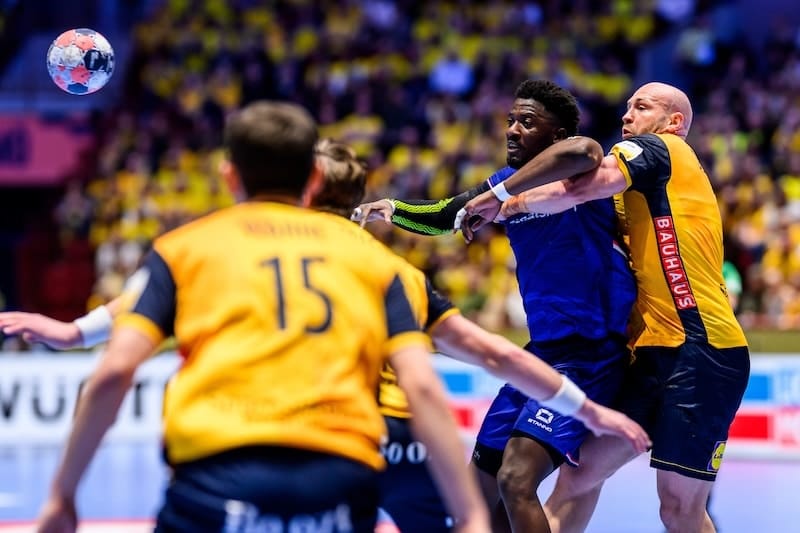
Leaving home at 18, Reinier Taboada carried more than a handball dream across the Atlantic – he carried his family, his culture, and a deep sense of belonging. From the streets of Havana to the European handball stage, his journey has been shaped by sacrifice, adaptation, and identity.
“I am Cuban born, it’s in my blood — but I feel Dutch and Cuban in my heart,” he says to GoHandball.
More than a decade ago, handball first became a part of Reinier Taboada’s life in Havana, the city where he grew up surrounded by family, sport, and togetherness. In Cuba, life revolved around close bonds, shared routines, and a sporting culture that shaped both athletes and people.
“Life in Cuba was really good,” he says. “My family was very close. We did things together, and they were very invested in sport.”
Handball, in particular, was almost inevitable. His father had played the game, and although Reinier first tried volleyball, the influence from home proved decisive.
“My father played handball, that’s why I played too. I started when I was 11, in Havana.”
Attended Cuba’s sports school system
He grew up within Cuba’s sports school system, a structured environment where training and education went hand in hand. Mornings were spent on the court, afternoons in the classroom – a daily rhythm that left a lasting mark.
“It was a great time for me,” Taboada recalls. “It was the best way to become a handball player, but also to become a man.”
Despite limited resources and a sport that lacked financial backing, the joy of the game and the bond with teammates made the experience special. But at 18, his path took a dramatic turn. After representing Cuba at youth level and playing international tournaments like the Pan American Games, he made the difficult decision to leave for Europe.
Portugal became his first destination, where he joined the small club Avanca. For a teenager, the move meant far more than a change of league.
“It was really great experience being so young,” he says. “I learned how handball in Europe was, and a new culture. But it was tough being far away from my family in Cuba.”
Not easy to adapt to his new life
Adapting to European life was challenging, emotionally as much as professionally. The distance to home weighed heavily, and the reality of leaving family behind at such a young age was something few around him could fully understand.
“For a young man here in Europe, to know what it’s like to leave your family at a young age, they can’t understand,” he explains.
Having another Cuban teammate by his side proved vital during that period, helping him navigate both the court and everyday life. Slowly, Taboada found his footing, growing not only as a player but as a person.
That journey eventually led him to the Netherlands – not just professionally, but personally. Today, he is married to a Dutch woman and is the father of two children. When the opportunity to represent the Dutch national team emerged, it felt like a natural next step.
“The coach contacted me and asked about my Dutch connection, and if I could represent the country,” he says. “I said, why not — to keep improving as a player.”
Eligibility took time. Paperwork stretched over several years, and he came agonisingly close to playing at the World Championship last year before circumstances ruled him out. When the chance finally arrived, it meant everything.
“The whole process took two or three years. Now I’m really happy, enjoying the time here. It’s amazing to play this tournament.”
Family members in the stands
One of the most emotional moments came off the court. During the match against Sweden, parts of his family were in the stands, including his brother, who lives in Copenhagen, as well as his wife and children.
“It’s really nice to have them here, almost my whole family,” he says. “Especially at this event, my first big one.”
His parents remain in Cuba, a reality that still weighs heavily. He visits when possible, once every year or two, but the distance never truly disappears.
“Of course I miss Cuba,” he admits. “It’s the place where I grew up, my family is there. I miss the sun and everything about Cuba. But at least part of my family is here, and that gives me energy.”
Asked how he identifies today, the answer comes without hesitation.
“Both, definitely. I am Cuban born – it’s in my blood. But I feel both Dutch and Cuban in my heart.”
Within the Dutch squad, Taboada has embraced a role built on calmness and experience. On and off the court, he leads quietly, contributing with positivity, balance, and defensive strength.
“I’m a really quiet, calm guy,” he says. “I try to be happy and give a cool, positive energy to the team. That’s my role here.”
From Havana to Holland, Reinier Taboada’s journey is one of resilience, identity, and growth – shaped by separation, strengthened by family, and driven by a love for the game that has carried him across continents.